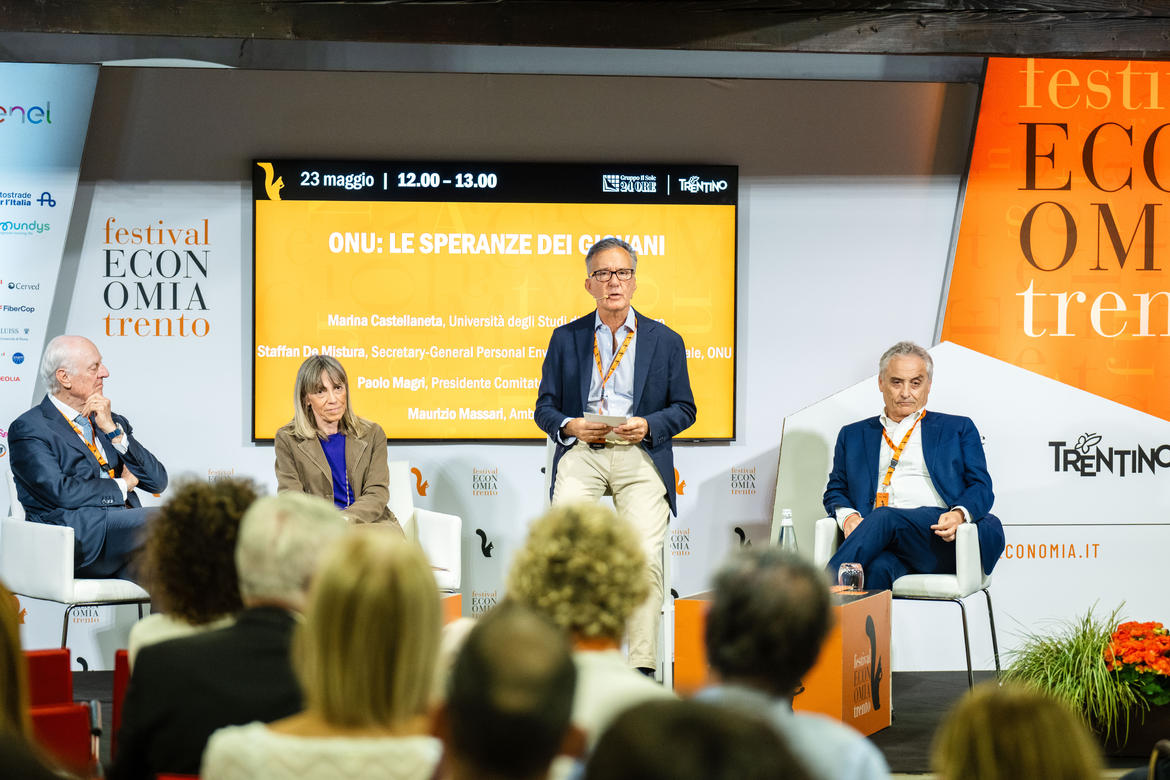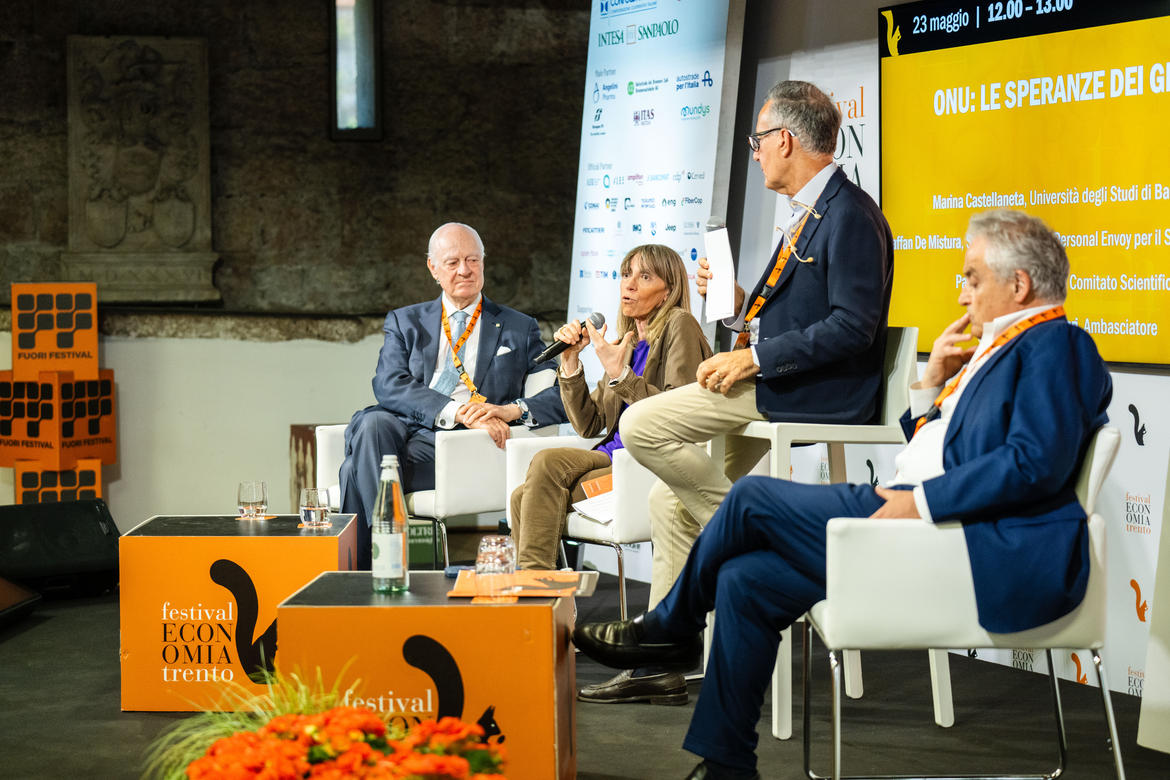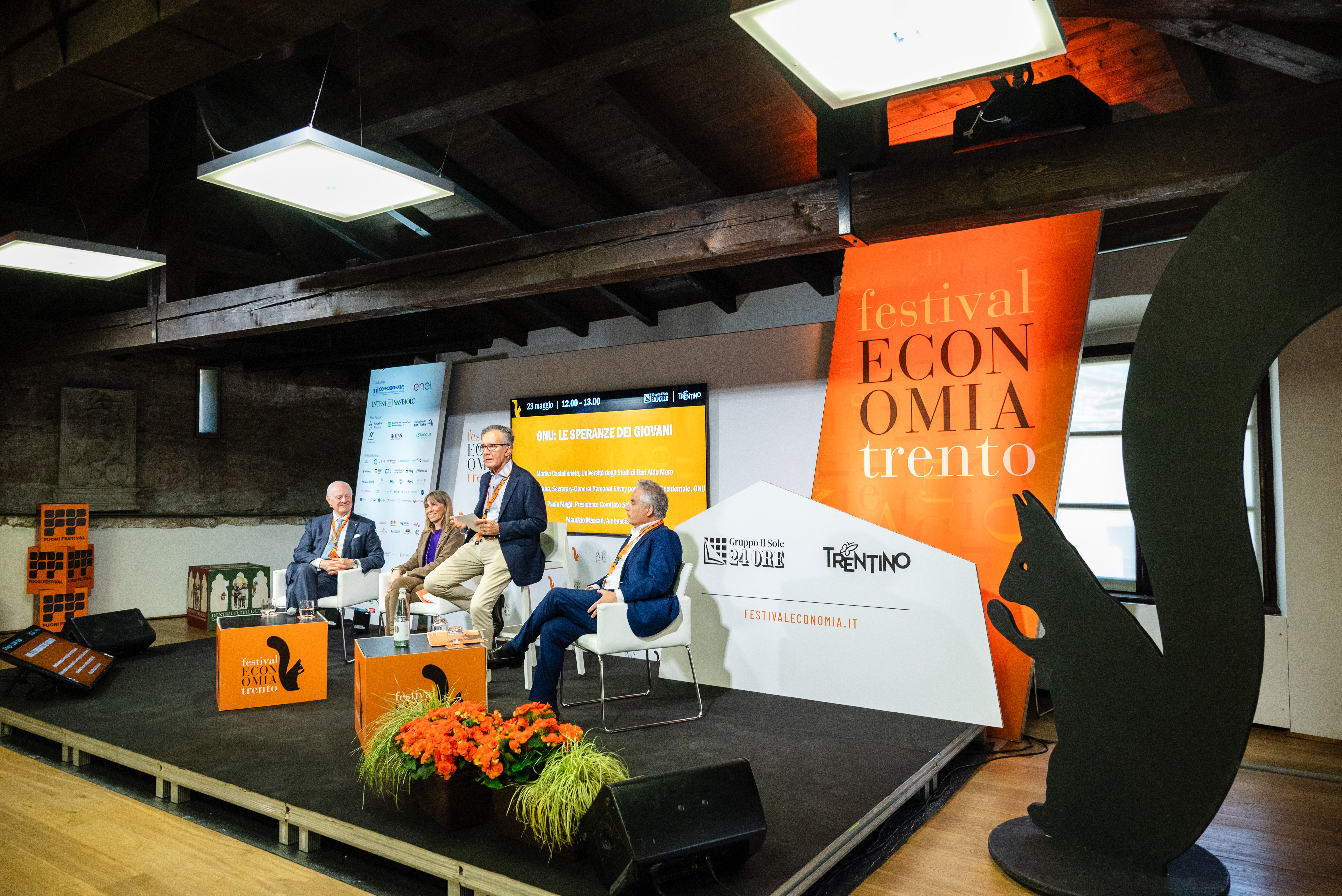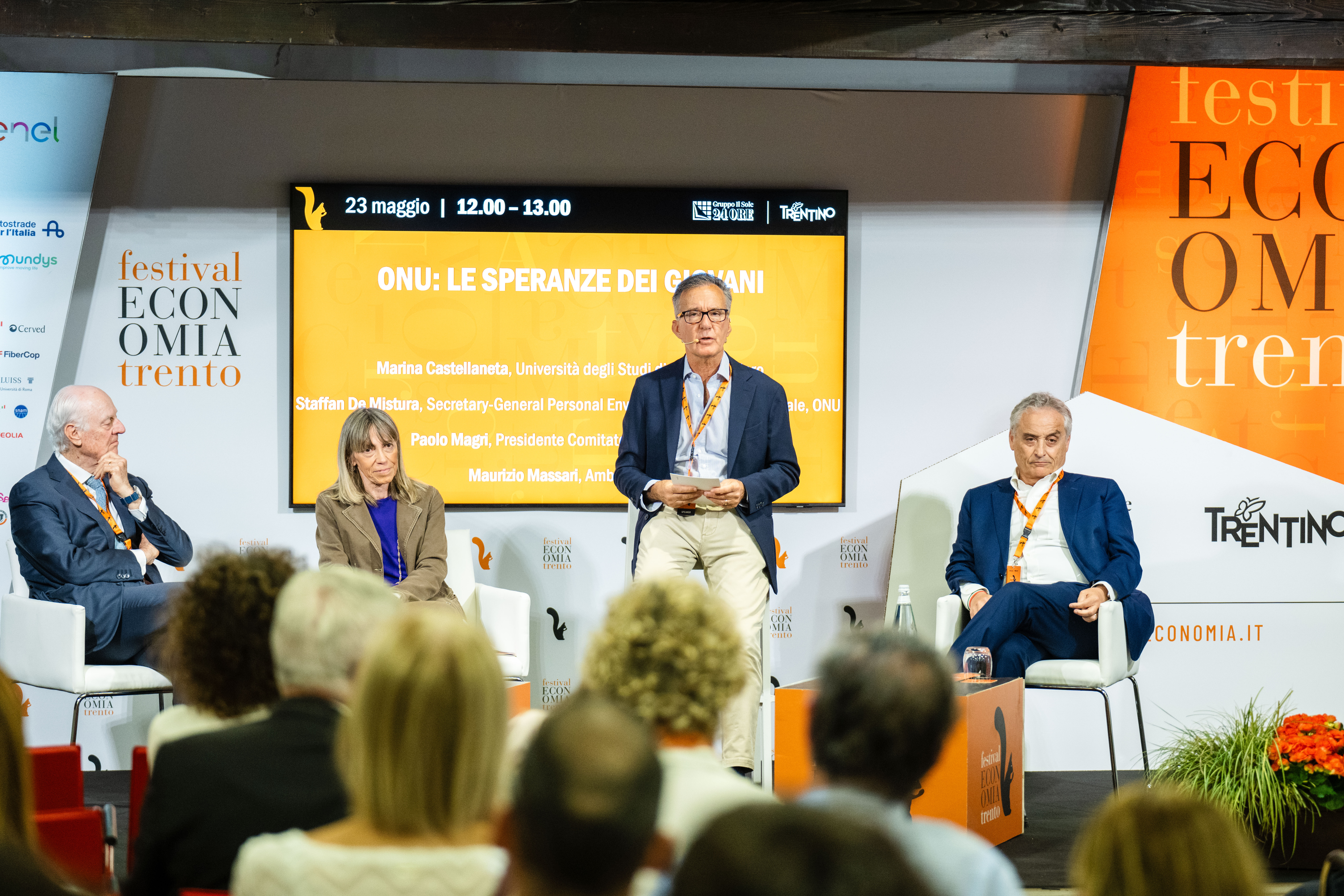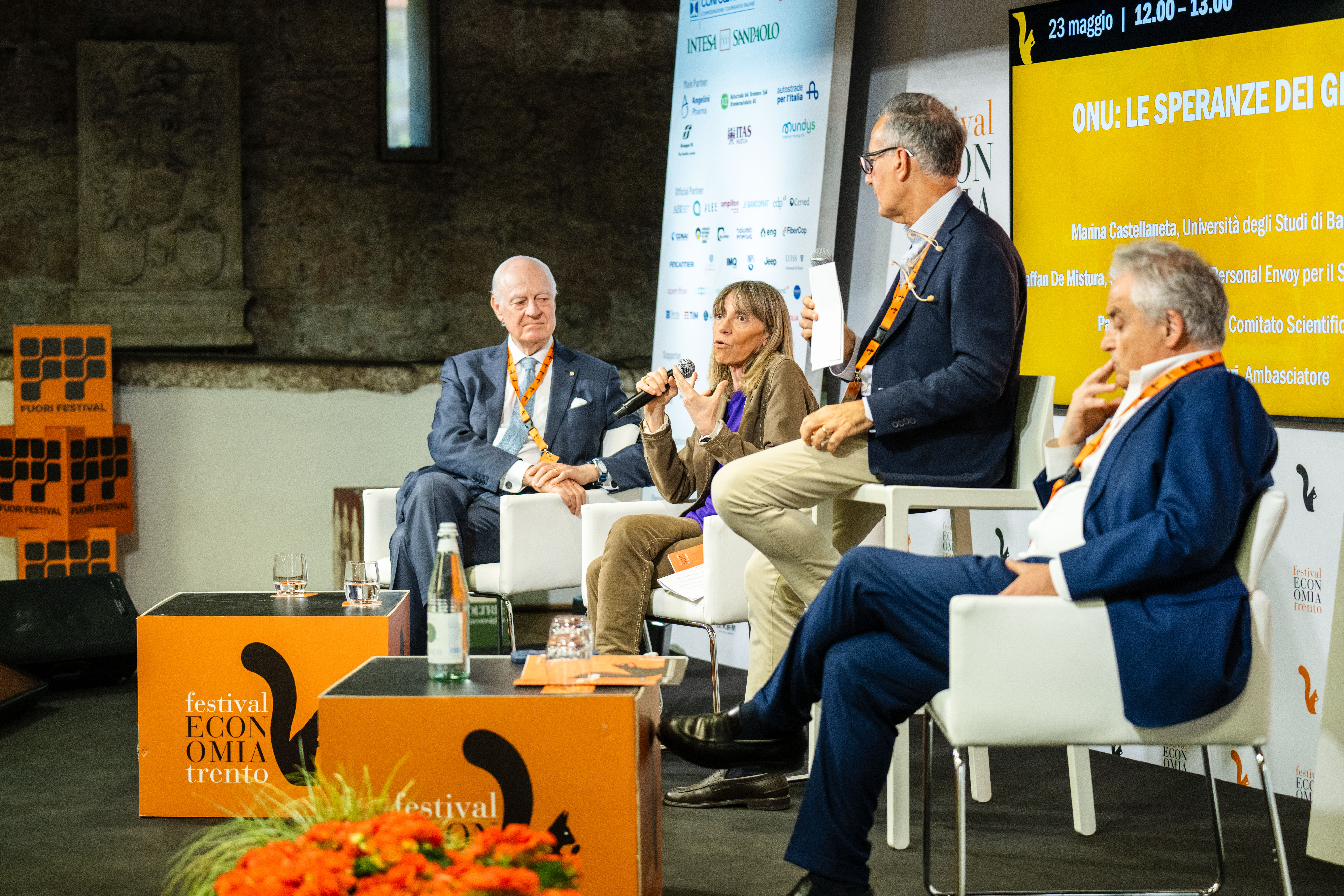






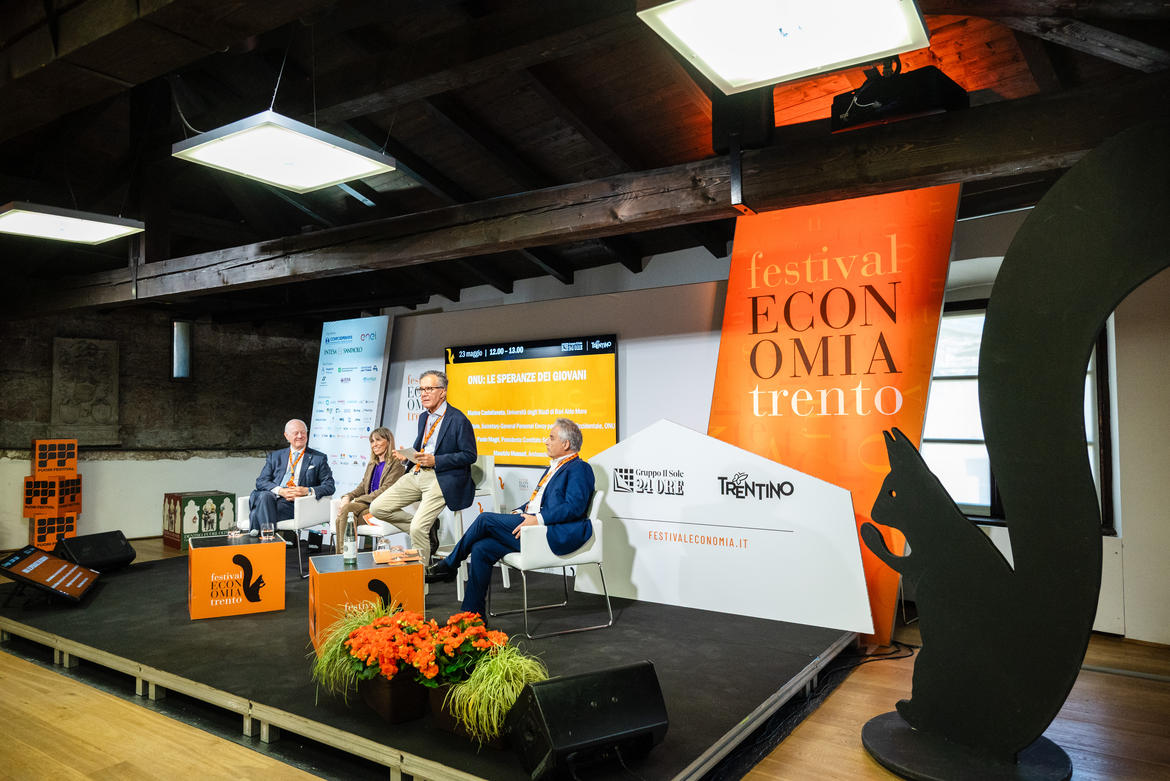
The panel discussion "UN: the hopes of young people", held within the programme of the Trento Festival of Economics in collaboration with ISPI - Italian Institute for International Political Studies, attracted a full-capacity audience and confirmed the strong public interest in the ongoing debate on the future of the United Nations and multilateral cooperation.
The first round of interventions examined the role and effectiveness of the United Nations in today’s fragmented geopolitical landscape, balancing critiques with arguments defending the organization’s continuing relevance and adaptability. Marina Castellaneta stressed that the system is grounded in the principle of “the prohibition of the use of force”, except in self-defense or when authorised by the Security Council. She underlined that while the veto power of the five permanent members (China, France, Russia, the UK and the USA) often limits collective action, the Council has nevertheless helped structure relations among states and maintain a degree of global balance. Maurizio Massari focused on the paralysis of the Security Council in an era of renewed great-power competition, arguing that the UN works beyond this single body but is often judged through it. The system was more effective in the 1990s, while today it is frequently blocked by competing vetoes, citing Gaza as a key example. He also warned against alternative governance structures, such as the Board of Peace, remarking that “the toy is broken” when major powers dominate decision-making. Staffan de Mistura defended the UN as an imperfect but essential institution, created “to prevent the world from going to hell, not to reach paradise”. He emphasised that the organization extends far beyond the Security Council, highlighting its humanitarian role and operational creativity. Drawing on experiences such as famine relief operations in Ethiopia and the grain corridor initiative in Ukraine, he argued that even in moments of political deadlock, the UN can still act effectively through pragmatic interventions.
The second round addressed the UN’s financial crisis, the erosion of international legal constraints, and the shift toward more transactional forms of global negotiation. Massari described an unprecedented financial strain on the UN following US funding cuts under the Trump administration in 2025. The organisation depends on a combination of a small regular budget and larger voluntary contributions, historically led by the United States - which has now significantly reduced payments and accumulated around 4 billion dollars in arrears. No other major power has stepped in to compensate. Citing the example of Trump’s claim that the only limit to his action is his own morality, Castellaneta warned against rhetoric suggesting that political leaders can act above international law. This, she argues, reflects a dangerous weakening of legal norms, ultimately leading to instability also domestically. Finally, she stressed the importance of younger generations in defending multilateral values, recalling that “young people are the hope of the UN”. De Mistura focused on the changing style of negotiation, noting that today’s envoys are often more political and transactional than traditional diplomats. While acknowledging the drawbacks, he argued that this approach can still be effective when it leads to concrete outcomes, especially if humanitarian arguments are reframed in terms of tangible interests.
The Q&A session focused on the Security Council representation and the profile of a future Secretary-General, before closing with reflections on whether multilateralism can still inspire hope. Massari noted that a unified European seat in the Security Council is not currently feasible and that deeper reform is constrained by the UN Charter and political divisions. On the Secretary-General, he stressed that expectations vary across blocs. Castellaneta underlined that long-discussed institutional reforms remain politically blocked, and that the current international context makes structural change unlikely. Still, she rejected the idea that this means paralysis, pointing to ongoing UN operational work as evidence that the system is still active and necessary. De Mistura emphasised the need for a future Secretary-General who combines moderation with authority and independence, suggesting a single mandate and stronger leadership capacity. He also stressed the importance of female leadership and argued that credibility and pragmatism are essential in today’s political environment. In closing, all speakers expressed cautious optimism: Massari and Castellaneta highlighted the continuing necessity of multilateralism for global challenges, while de Mistura argued that despite current difficulties, the UN remains indispensable.