






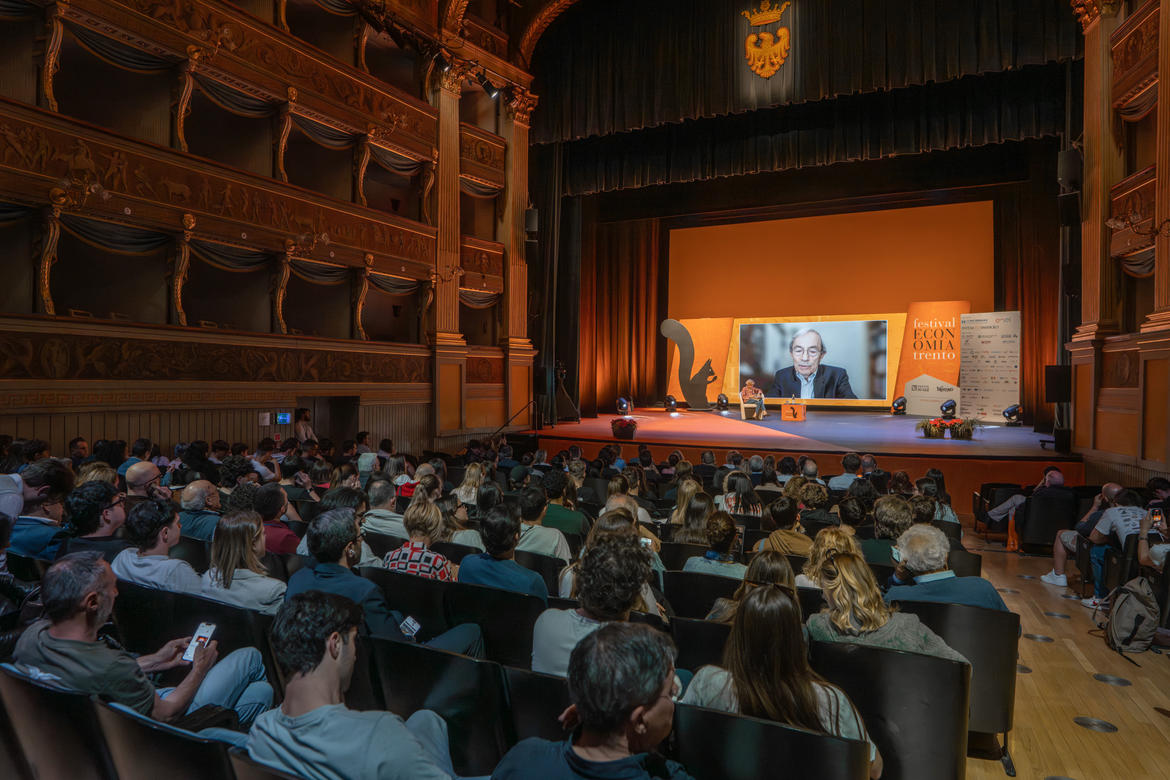
“Workforce skills in demand in the age of AI” was the compelling topic behind the event on stage at Teatro Sociale on its opening day, the 20th of May. Sir Christopher Pissarides, Nobel Laureate in Economics 2010, speaking via livestream, and Giulia Crivelli, journalist of Il Sole 24 Ore, addressed a wide audience during the 21st edition of the Trento Festival of Economics, highlighting the critical aspects of AI and the future of the labour market.
AI is profoundly changing not only the job market, but also how we prepare for it. Amid this change, frictions emerge – mainly related to uncertainty. “We do not know where this is going. Nobody knows.” – states the Nobel Laureate. He continues: “Yet if you don’t know where a process is going, you do not know in which skills to invest. Managers are worried about losing productivity, and workers are worried they will lose their jobs. The best thing we can do is look at the knowledge we will need: understanding data, basic STEM, and understanding the basics. You need to learn how to learn in the future”, he asserts.
Prompted by Ms. Crivelli’s questions, Sir Christopher Pissarides speaks his mind clearly: according to him, soft skills will be increasingly in demand. Often perceived as the easiest skills to have, they are actually the most complex ones. In a post-industrial service economy, most jobs are about people interacting with other people (such as customers or colleagues), and no machine can replace that. On whether we are “naturally born” with soft skills or they can also be learned, the answer is simple: they can be taught, and we all need to practice them - “and that’s where psychology can help you more than economics, I’m very sorry to say”, admits the Nobel Laureate with a smile.
On productivity and AI, “claims are wild, but I don’t think they all correspond to reality”, he states. There is evidence of AI enhancing productivity when it comes to the manufacturing sector, but the economy is made up of many sectors. Every company you ask claims to be using AI, but the impact has been seen only timidly. What happens is that most companies are using AI, but they keep workers because they do not trust the tool. “If you want to increase productivity, don’t rely on AI”, he concludes.
The meeting also addressed the concerns of young people and the current job market, and also “the elephant in the room”, namely the enormous quantity of energy and water that the large AI data centres need in order to continue working. Depending on how it is used, AI could also contribute to improving the environmental sector. And about physical AI, the Nobel Laureate asserts: “I am not so concerned because there are not many people employed in the jobs robots could be doing. I visited a car company, and there were a few people with laptops and machines doing the job. What I am more worried about is the application in the service sector. Even though physical AI could work together with humans, we do not know how that could be".


